“If the message touches the heart, it never dies.”
Jay Kruse
“All art forms are delivery systems - precision instruments for transmitting meaning across the gap between minds. The question I’ve spent my life asking is: how do you engineer one that actually works?”
Jay Kyle Kruse was born in Houston in 1968 into a family of makers. His father carved figurative sculpture and drawing came early - complete figures before preschool. Art wasn’t a choice; it was assumed.
As a teenager, music took over. He became a serious bassist - moving from rock to blues to jazz - before encountering the reed and bamboo flutes of the Middle East and Indian subcontinent. These instruments, shaped by centuries of refinement, were built on proportion systems so precise they had barely changed in a thousand years. He eventually sold everything he owned and bought a one-way ticket to Turkey to study within his teacher’s lineage. The experience was demanding, immersive and formative.
Back in the United States, he built a parallel practice - performing, teaching and constructing instruments by hand. Through this work, one principle kept surfacing: geometry. Not as decoration, but as the underlying system governing proportion, resonance and why certain forms feel inevitable while others merely function.
That realization became foundational. When Kruse returned to visual art after decades away, he wasn’t returning to painting - he was extending the logic of instrument-making into a new medium.
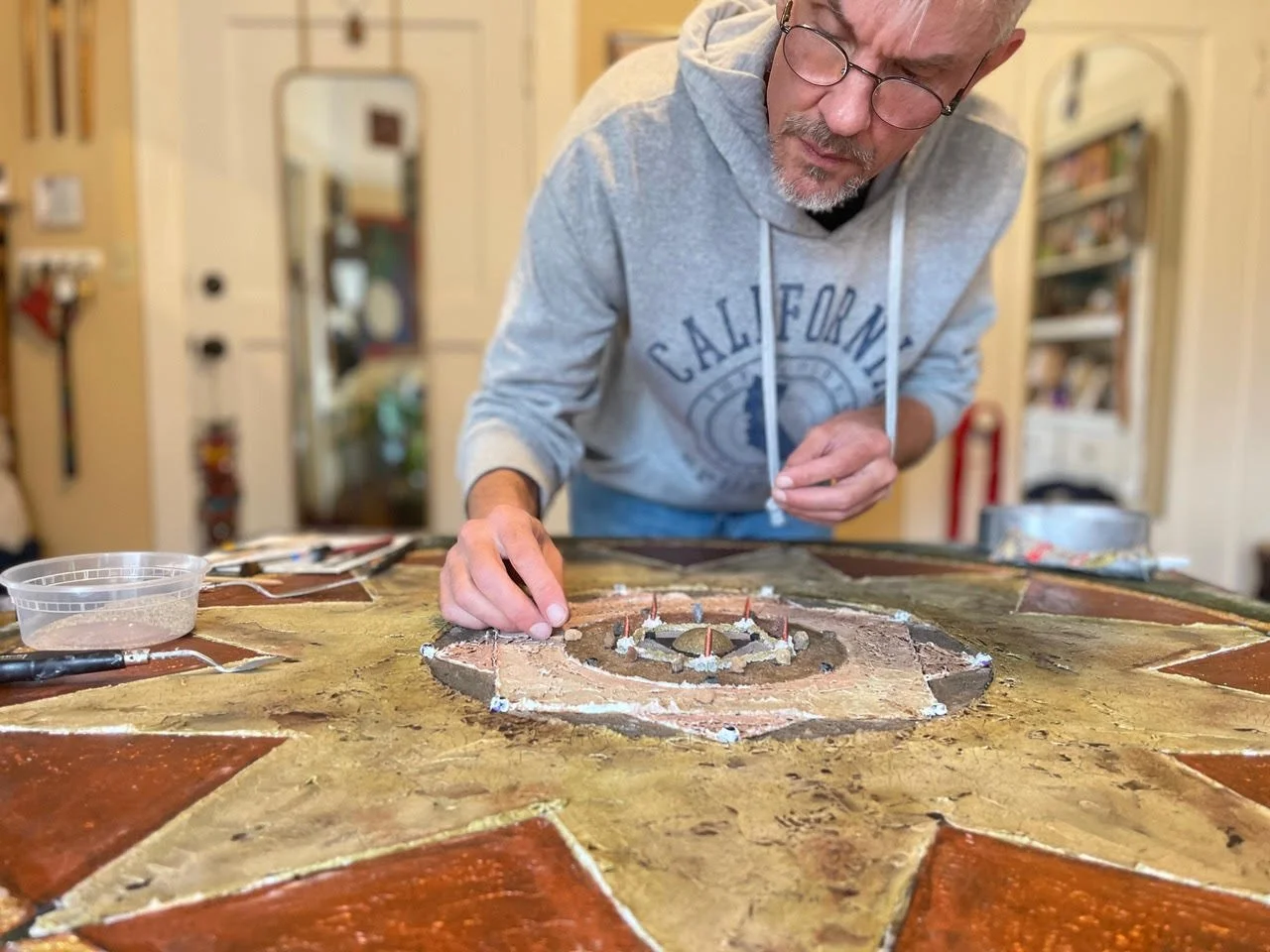
The Chronoglyph series applies these same proportion systems to works on panel - layered, structural compositions built with internal logic. Recent works expand this approach through material systems: metals, mineral elements, resin and dense surface treatments selected with the same deliberateness a luthier brings to wood and tone. These are not decorative objects. They are built to do something - and built to last.
Kruse operates under the studio name Heretic Works, from the Greek hairetikos, meaning “one capable of choosing.” It serves as a quiet manifesto: each piece is a deliberate decision about what knowledge to encode, what proportions to preserve and what objects are worth carrying forward.
He is based in Oakland, California, where he maintains an active practice across music, instrument-making and visual art. Commissions and teaching inquiries are welcome.